TL;DR: Australian Design Rules (ADRs) are the national safety standards every tyre and wheel must meet when a vehicle is built or imported — mainly ADR 23 for passenger-car tyres and ADR 42 for tyre-and-rim selection and the tyre placard. Once your car is on the road, in-service fitment rules (VSB 14) and state roadworthy laws take over. Both must be satisfied.
What are the Australian Design Rules (ADRs)?
The Australian Design Rules are the national technical standards for vehicle safety, security and emissions. They are administered by the federal Department of Infrastructure, Transport, Regional Development, Communications and the Arts under the Road Vehicle Standards Act 2018. Every new vehicle built in or imported into Australia must comply with the ADRs that apply to it before it can be supplied to the market.
Here is the point most drivers miss: the ADRs are a manufacturing standard. They govern how the car and its tyres leave the factory. The day you drive out of the dealership, a second layer of rules — the in-service and modification standards in the National Code of Practice (VSB 14) and your state's road-transport regulations — governs what you are allowed to keep on the car. This guide explains both, in plain English, for an Australian audience.
Which ADRs actually cover tyres and wheels?
Only a handful of the roughly eighty ADRs touch tyres and rims. These are the ones that matter.
| ADR | Covers | What it means for you |
|---|---|---|
| ADR 23 — Passenger Car Tyres | New pneumatic tyres designed for passenger cars, other light vehicles and light trailers. In force since 1973. | Any passenger tyre sold for road use must meet minimum standards for strength, endurance, high-speed performance and correct sidewall marking. |
| ADR 24 — Tyre and Rim Selection | Originally set the rules for matching tyres and rims to the vehicle and for the tyre placard. Obsolete — ceased to apply to new vehicles from 9 December 2003. | Its requirements were folded into ADR 42, so the placard and selection rules still exist; they just live in a different rule now. |
| ADR 42 — General Safety Requirements | The catch-all safety rule. Now includes the former ADR 24 tyre-and-rim selection provisions and the tyre placard requirement. | This is why your car must carry a tyre placard and why the fitted tyres must suit the vehicle's mass and speed. |
| ADR 96 — Commercial Vehicle Tyres | New pneumatic tyres designed primarily for heavier commercial vehicles. | Relevant to trucks, buses and some heavy light-commercials rather than the family car. |
There is no separate ADR that regulates aftermarket alloy wheels once the car is in service — wheel fitment is handled by VSB 14 and state rules, which we cover below.
What does ADR 23 require of a tyre?
ADR 23 does not tell manufacturers how to build a tyre — it sets performance benchmarks the tyre must pass, plus the markings it must carry. A compliant passenger tyre has to withstand heat, endurance and high-speed testing, and its sidewall must legibly show the size, the construction, the load index, the speed rating and the week-and-year date of manufacture. If you have ever wondered why every number on the sidewall is there, ADR 23 (harmonised with the equivalent UN regulation) is the reason. Our guide to reading a tyre sidewall decodes each one.
What is the tyre placard, and why is it an ADR requirement?
The tyre placard is the small factory label — usually on the driver's door jamb, inside the glovebox, or on the fuel-filler flap — that lists the tyre sizes, load and speed ratings and the recommended cold inflation pressures for your specific vehicle. Displaying it is a legal requirement carried over from ADR 24 into ADR 42. It is the single most authoritative source for what your car was designed to run. Our full guide to reading your car's tyre placard walks through every field, including when a placard can be safely departed from.
Do ADRs apply once the car is on the road?
Not directly. ADRs are certified at manufacture or import. After that, the rules that a police officer or roadworthy inspector applies to your tyres come from the in-service standards. Two things govern replacement tyres and wheels:
- VSB 14 (the National Code of Practice for Light Vehicle Construction and Modification) — the national reference for what modifications are acceptable and when a certificate is needed.
- Your state or territory road-transport regulations and roadworthy scheme — the enforceable law, which adopts VSB 14 as its baseline but can differ in the detail.
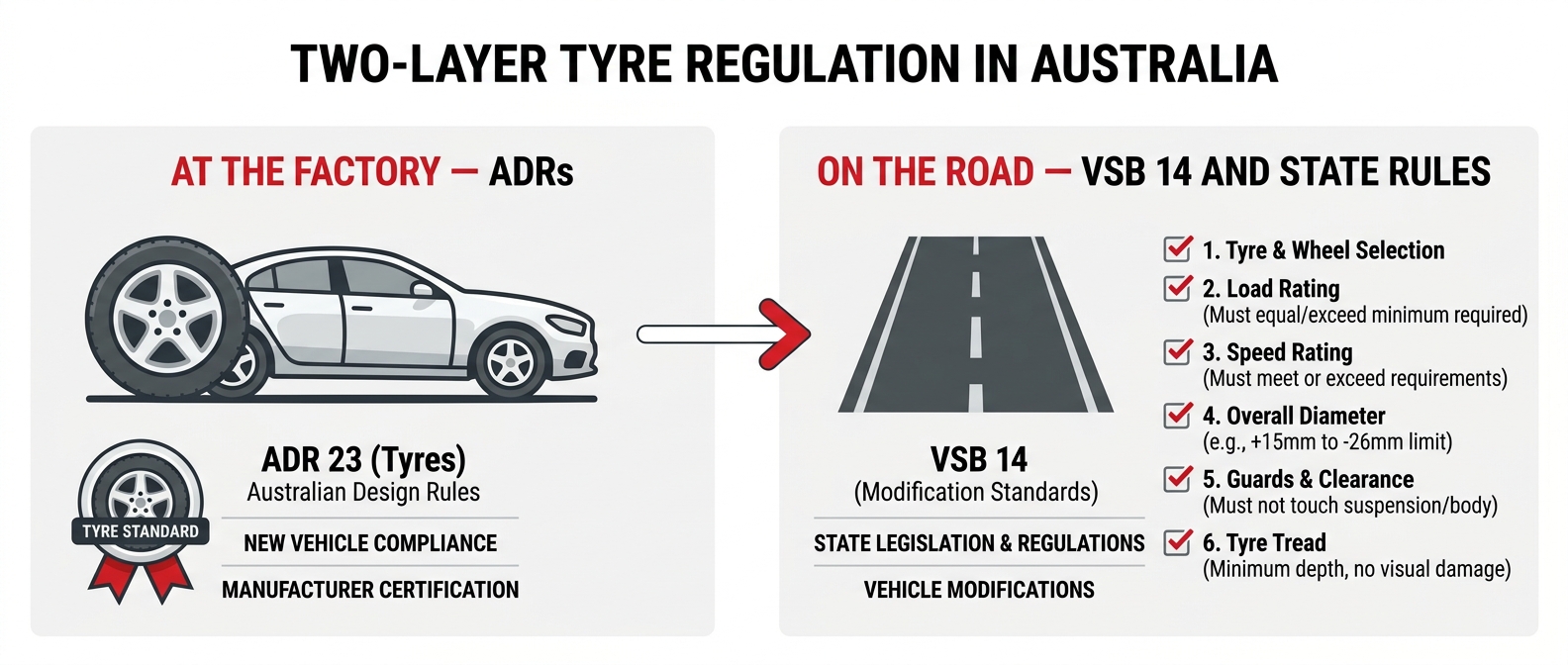
Under VSB 14 Section LS, replacement tyres on a normal passenger car must generally stay within a defined size band, keep the load rating at or above the placard figure, keep an adequate speed rating, and sit entirely within the guards. The commonly cited baseline figures are below — always confirm the current numbers with your state road authority, as they can change.
| In-service rule (guide only) | Passenger car | Off-road 4WD / goods vehicle |
|---|---|---|
| Overall diameter change | Not more than +15 mm larger or −26 mm smaller than a manufacturer-designated tyre | Up to +50 mm larger diameter |
| Tyre width | Not more than 30% wider than the widest optional tyre | Not more than 50% wider than the widest optional tyre |
| Wheel track increase (before certification) | Up to 25 mm beyond the manufacturer's maximum | Up to 50 mm beyond the manufacturer's maximum |
| Load rating | Must be equal to or higher than the placard rating | |
| Guard coverage | Wheel and tyre must be contained within the bodywork or mudguards (including flares) with the wheels straight ahead | |
Go beyond these bands and you generally need certification from a licensed signatory or engineer. Because the reason those diameter limits exist is to keep your speedo, ABS and stability control accurate, it is worth understanding why rolling diameter decides your legal tyre size and when you need an engineer's certificate for bigger wheels.
What about tread depth — is it an ADR rule?
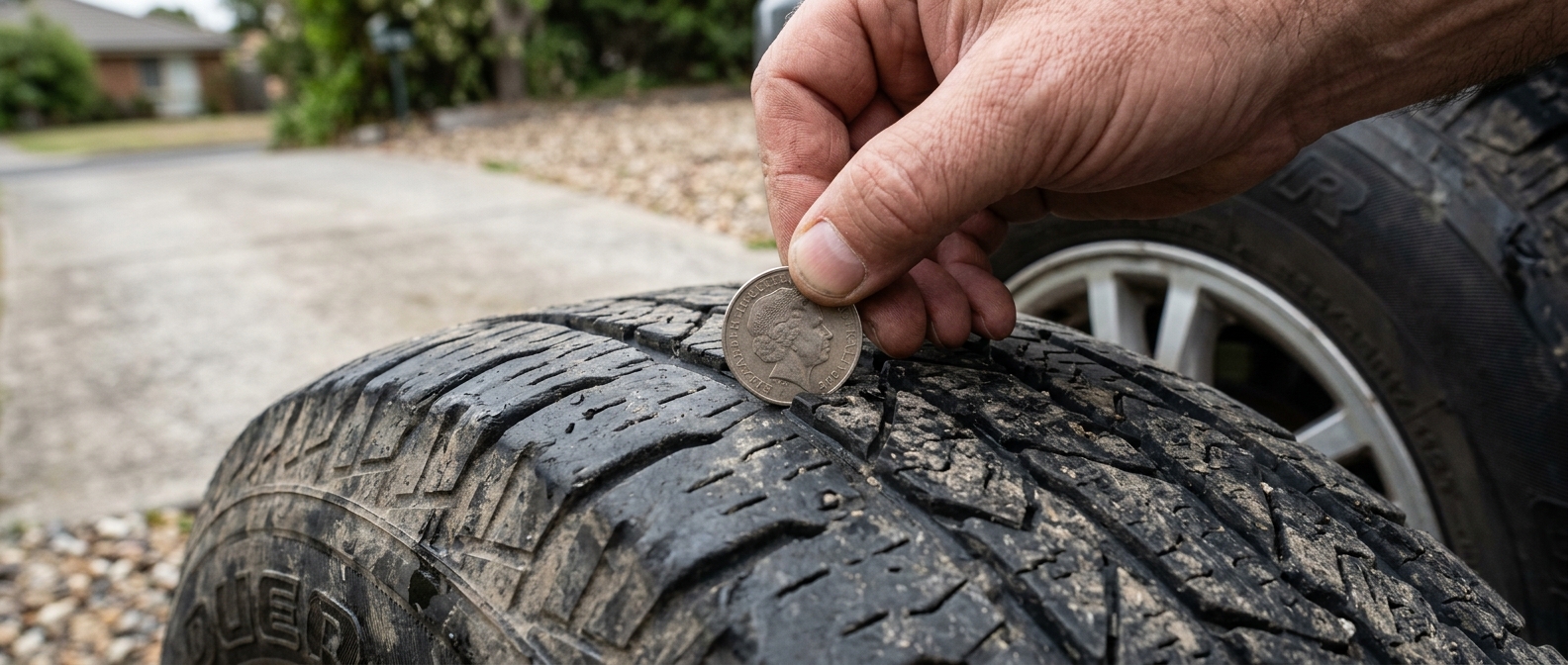
Minimum tread depth is an in-service roadworthy rule, not an ADR. In Australia the legal minimum is 1.5 mm across all principal grooves — not the 1.6 mm figure you will see on many websites that have copied UK or European content. It is a common and important error. Our full explainer on the 1.5 mm rule and how to find your tyre wear indicators covers it in detail.
What happens if your tyres or wheels don't comply?
Non-compliant tyres can trigger a defect notice (a yellow or red sticker), a fine, and a failed roadworthy inspection. Fitting tyres below the placard load rating is both an offence and a genuine safety risk — see what happens if your tyres don't meet the placard load rating. If your vehicle is a 4WD and you are weighing up chunkier rubber, our guide to whether mud-terrain tyres are legal on Australian roads applies the same framework to off-road tyres. The industry's own fitment reference, the Tyre and Rim Association standards, underpins much of it.
Frequently asked questions
Is ADR 23 the only tyre rule I need to know?
No. ADR 23 covers passenger-car tyres at manufacture. Day-to-day legality on the road comes from VSB 14 and your state roadworthy rules, which cover fitment, tread depth and modifications.
Do aftermarket wheels have to meet an ADR?
There is no dedicated ADR for aftermarket alloy wheels in service. They are governed by VSB 14 and state rules — the wheel must fit correctly, keep the tyre within the guards, and not foul the body, brakes or suspension. Quality marks like JWL and VIA are covered in our replica wheels guide.
Where is ADR 24 now?
ADR 24 (tyre and rim selection, plus the placard) became obsolete for new vehicles from 9 December 2003. Its requirements were absorbed into ADR 42, so the placard and selection rules still apply.
Does an LT-construction tyre change anything?
Light-truck (LT) tyres carry different load and pressure characteristics to passenger (P-metric) tyres. They can be legal provided they meet the load and speed requirements for your vehicle — see LT vs P-metric tyres.
Who enforces the rules?
The federal Department administers the ADRs at manufacture/import. State and territory road authorities and police enforce the in-service rules through roadworthy inspections, defect notices and roadside checks.
Bottom line
The ADRs get compliant tyres and wheels onto your car at the factory; VSB 14 and your state's roadworthy rules decide what you can keep on it afterwards. Match the placard, keep the load rating, stay within the size bands and the guards, and hold 1.5 mm of tread — do that and you satisfy both. Figures such as diameter and track limits are national guides that can change and vary by state, so confirm anything before you buy with your state road authority or a licensed signatory.



0 Comments