Category: Australian Legality and Compliance. Australian English throughout.
Legal Minimum Tyre Tread Depth in Australia: The 1.5mm Rule Explained
Quick answer: In Australia the legal minimum tyre tread depth is 1.5mm in all principal grooves, right around the tyre and across the tread. That is the figure in every state and territory — it is not the UK's 1.6mm. A tyre worn below 1.5mm, or with a tread wear indicator touching the road, is unroadworthy and can earn you a fine and a defect notice.
What is the legal minimum tyre tread depth in Australia?
The national rule is simple and consistent: tyres must have a minimum tread depth of 1.5mm in all principal grooves. Transport Victoria states it plainly — "Except at the tread wear indicators, tyres must have a minimum tread depth of 1.5mm in all principal grooves" — and the RACV confirms the same 1.5mm figure applies to Australian vehicles. The principal (or "main") grooves are the wide circumferential channels that carry water away; the measurement must be met everywhere around the tyre and across the tread width.
This requirement flows from the national Australian Light Vehicle Standards and is adopted by each state and territory's roadworthiness rules, so the number is the same whether you're in Sydney, Perth or Darwin. For the wider context, see our plain-English guide to ADR requirements for tyres and wheels.
Is it 1.5mm or 1.6mm? Clearing up the confusion
You'll see 1.6mm quoted online, and it is wrong for Australia. 1.6mm is the United Kingdom and European minimum. A lot of tyre content is copied from overseas, so AU readers often see the UK number by mistake. On Australian roads the legal floor is 1.5mm. The practical difference is tiny, but if you're reading a rule to stay legal, use the Australian figure and the Australian source.
| Region | Legal minimum tread depth |
|---|---|
| Australia (all states/territories) | 1.5mm in all principal grooves |
| United Kingdom / Europe | 1.6mm (central 3/4, full circumference) |
Where is tread depth measured — and what about the smaller grooves?
The 1.5mm minimum applies to the principal grooves only. Transport Victoria notes that the shallower secondary grooves (the fine sipes and decorative channels) can be below 1.5mm without making the tyre unroadworthy. What counts is the depth in the main water-clearing channels, measured at the worn-test points around the tyre. A tyre can also fail for "excessive uneven wear across its width," so a tyre that's legal in the centre but bald on one edge is still a problem. If you're chasing uneven wear, our guide on when to replace tyres covers the warning signs.
How do you check your own tread depth?
There are three reliable ways, from quickest to most accurate.
Tread wear indicators (TWI)
Every road tyre has small raised rubber blocks set into the bottom of the principal grooves. The RACV describes them as "little rubber blocks that protrude from the low point in the primary tyre grooves." When the surrounding tread wears down level with these bars — so the indicator "contacts the road surface at any point" — the tyre is at the legal limit and is unroadworthy. Learn exactly where to find them in our guide to tyre wear indicators.
The 20 cent coin test
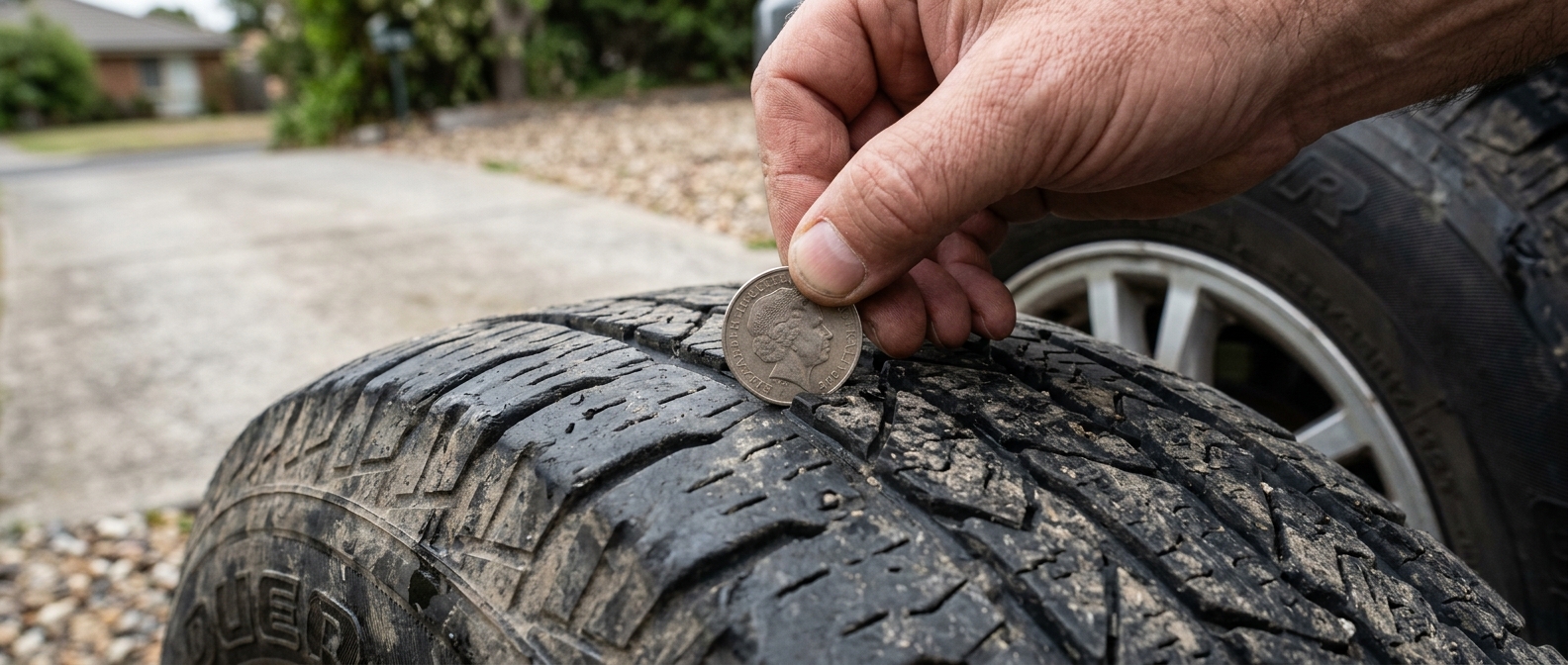
No gauge handy? Use an Australian 20 cent coin. The bill of the platypus sits about 3mm in from the edge, so if your tread doesn't reach the platypus's bill, you're getting close and should plan to replace. It's a conservative, basic check rather than an exact measurement — but because it flags you at around 3mm, it gives you a safety buffer above the 1.5mm legal floor. More no-gauge methods are in how to check your tread depth without a gauge.
A tread depth gauge
A cheap handheld depth gauge gives a precise millimetre reading in the groove. It's the only way to know your exact depth, and worth keeping in the glovebox.

Should you really wait until 1.5mm?
Legally you can run to 1.5mm; in the wet, you shouldn't. As tread shallows, the tyre can't channel water away, so braking distances grow and the risk of aquaplaning climbs sharply. The RACV and many tyre makers recommend replacing at around 3mm "to ensure optimal grip in wet weather and other slippery conditions." The hard truth of driving on worn rubber is spelled out in our piece on wet-road braking distances with worn tyres. Treat 1.5mm as the point you must not cross, and 3mm as the point to start shopping.
What does an illegal tyre cost you?
Driving on tyres below 1.5mm is an offence in every state and territory. Penalties are typically applied per tyre, so four worn tyres can multiply quickly, and fines usually come with demerit points. On top of the fine, a police officer or inspector can issue a defect (yellow or red) notice ordering you to rectify the tyres before the vehicle is driven again — our guide to tyre defect notices explains the sticker system, and fines and demerits for illegal tyres has the detail. Exact dollar amounts and demerit points differ by jurisdiction and change over time, so confirm the current penalty with your state or territory road authority.
Worn tyres will also fail a mandatory inspection. See whether worn tyres fail a NSW pink slip, a Victorian roadworthy, or a Queensland safety certificate — the short answer in each case is yes.
When else must a tyre be replaced?
Tread depth isn't the only trigger. Transport Victoria requires that tyres with "deep cuts, cracks, bulges or any other damage" be removed from the vehicle, regardless of tread. A tyre with plenty of tread can still be unroadworthy if the sidewall is damaged or the casing is separating. And because rubber degrades with age, a tyre more than five or six years old deserves a professional assessment even if it looks fine.
Bottom line: Australia's legal minimum tyre tread depth is 1.5mm in all principal grooves, the same in every state — not the UK's 1.6mm. Check it with the tread wear indicators or a 20 cent coin, but for wet-weather safety replace at around 3mm. Below 1.5mm your tyres are illegal, will fail inspection, and can earn a fine and a defect notice.
Frequently asked questions
Is the legal tyre tread depth 1.5mm or 1.6mm in Australia?
It is 1.5mm in all principal grooves across every Australian state and territory. 1.6mm is the UK and European figure and does not apply here.
How do I know when my tyre reaches 1.5mm?
When the tread wears level with the tread wear indicator bars moulded into the bottom of the principal grooves, the tyre is at the 1.5mm legal limit and must be replaced.
Does the 1.5mm rule apply to the whole tyre?
It applies to the principal (main) grooves, right around the tyre and across the tread. Secondary sipes and fine grooves can legally be shallower than 1.5mm.
Can I be fined for each worn tyre?
Yes. Penalties are generally applied per tyre, so multiple worn tyres can mean multiple fines, usually with demerit points. Amounts vary by state — check your road authority.
At what tread depth should I actually replace my tyres?
For wet-weather safety, around 3mm. Grip and braking fall off well before you reach the 1.5mm legal minimum, so don't run them to the limit.
Suggested schema
Article + FAQPage structured data recommended for this page.


0 Comments