
Australian English. Figures current as a guide for 2026 — always confirm penalties and inspection rules with your state or territory road authority.
How do you check tyre tread depth without a gauge?
TL;DR: You can check tyre tread depth without a gauge using two free methods. Slot an Australian 20-cent coin into the tread grooves — if the tread doesn't reach the platypus's bill, you're near 3mm and should plan replacement. For the legal line, find the built-in tread wear indicator bars (moulded at 1.5mm, Australia's legal minimum) and check whether the tread is level with them.
Not everyone keeps a tread depth gauge in the glovebox, and you don't need one to know whether your tyres are getting dangerously worn. Two reliable, no-cost checks — the 20-cent coin test and the tyre's own tread wear indicators — will tell you when to start shopping and when you've hit the legal limit. This guide walks through both, plus how to check properly across the whole tyre so you don't miss uneven wear.
First, the number that matters: in Australia the legal minimum tread depth is 1.5mm across all principal (main) grooves, in every state and territory. That's lower than the 1.6mm figure you'll see on plenty of websites — that's the UK and European limit, and it gets copied onto Australian pages by mistake. We cover the rule in full in our guide to the legal minimum tyre tread depth in Australia.
The Australian 20-cent coin test, step by step
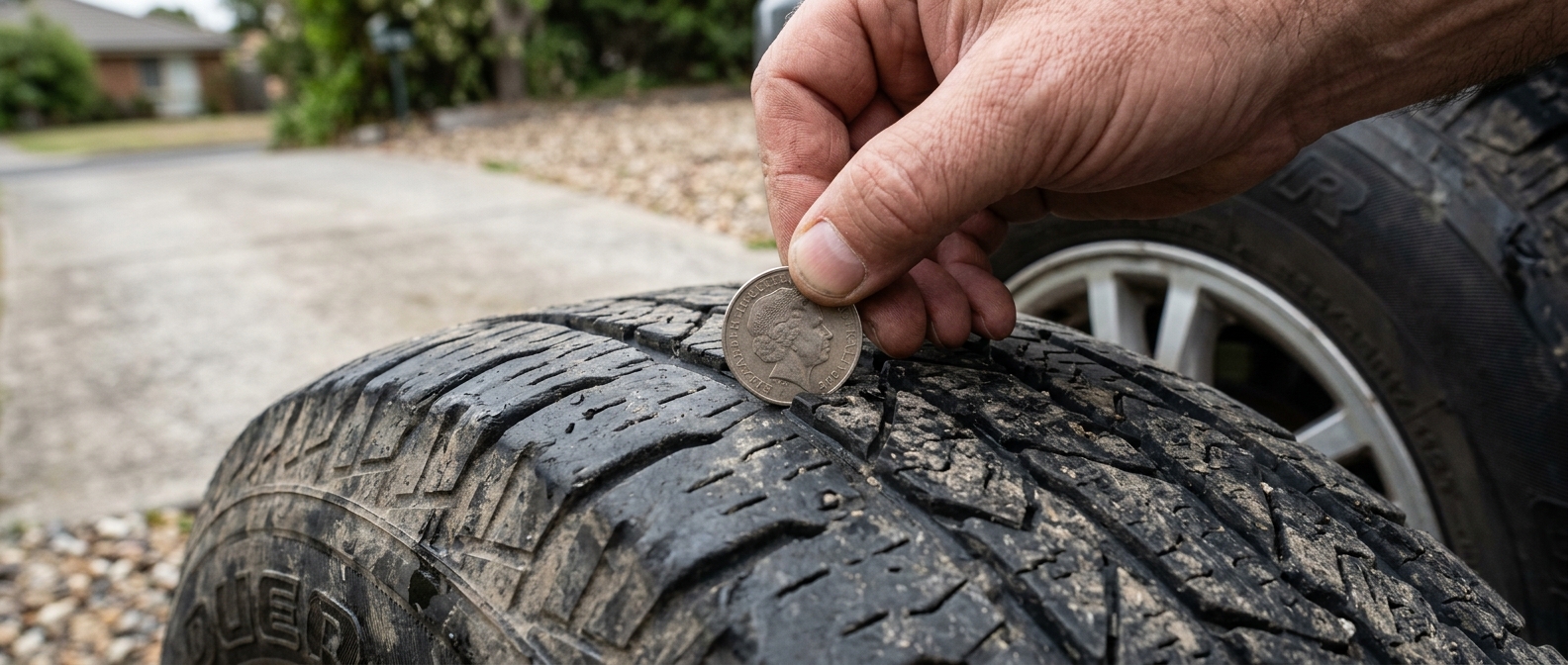
The 20-cent coin is the handiest tread checker most Australians already own. The platypus on the reverse of the coin sits roughly 3mm in from the edge, which makes it a useful early-warning reference — well above the 1.5mm legal minimum, at the point where wet-weather grip starts falling away sharply.
- Park on level ground with the wheels straight so you can reach the tread easily.
- Hold a 20-cent coin with the platypus pointing down and slot it into one of the central circumferential grooves.
- Push it in until it stops, then look at where the top of the rubber sits against the platypus.
- Repeat in the centre groove and both outer grooves, and at three or four points around each tyre.
Reading the result: if the tread covers the platypus's bill, you have more than 3mm left and plenty of grip. If the bill is fully visible with the rubber sitting at or below it, you're down around 3mm — still legal, but the point at which most tyre makers, including Bridgestone Australia, recommend planning replacement because wet grip drops off quickly below this depth.
The important thing to understand is what the coin does not do: it is a conservative "time to act" signal at about 3mm, not a precise measurement of the 1.5mm legal line. For that, use the tyre's built-in indicators.
How do the built-in tread wear indicators work?
Every tyre sold in Australia has tread wear indicators (TWIs) — small raised rubber bars moulded across the bottom of the main grooves at exactly 1.5mm high. They are the manufacturer's built-in gauge for the legal minimum. When the surrounding tread wears down until it sits flush with these bars, the tyre is at the legal limit and must be replaced.
To find them, look on the tyre's shoulder for a small triangle (▲) or the letters "TWI". Follow that marker straight in towards the tread and you'll see the raised bar bridging the groove alongside it. Most tyres have six or more of these markers spaced around the circumference. Run your fingernail or eye along the groove: if the bar is clearly below the tread surface, you still have tread; if the tread is level with the bar, you're done. Our full explainer on tyre wear indicators and what they mean shows exactly where to look.

Why you should check the whole tyre, not one spot
Tyres rarely wear evenly, so one measurement can lie. Always check the inner edge, the centre and the outer edge, and take readings at several points around the tyre. If one part is noticeably more worn than the rest, that's a diagnosis in itself:
| Where it's worn | Likely cause |
|---|---|
| Both edges, centre fine | Chronic under-inflation — see what happens if you underinflate your tyres |
| Centre only | Over-inflation — see centre wear on tyres |
| One inside or outside edge | Wheel alignment (camber/toe) — see inside-edge wear |
| Patchy or scalloped | Balancing or worn suspension — see cupping and scalloping |
A legal check is pass/fail at the worst point on the tyre. If any principal groove is at or below 1.5mm, the tyre is unroadworthy — even if the rest still has tread. For a deeper diagnosis, see how to read tyre wear patterns like a mechanic.
What about a matchstick, ruler or 5-cent coin?
You'll see other improvised methods online. A steel rule with a millimetre scale pushed into the groove will give you an actual reading if you can read it accurately — useful but fiddly. A matchstick or toothpick marked with a pen can work as a rough go/no-go gauge. The 5-cent coin is sometimes suggested, but its markings aren't a reliable reference point for Australian depths, so stick with the 20-cent coin. Honestly, the most dependable no-gauge method of all is the tyre's own wear bars, because they're built to the exact legal figure.
When should you actually replace your tyres?
| Tread remaining | What to do |
|---|---|
| Above 3mm | Safe — recheck every few months and after long trips |
| 1.5mm–3mm | Legal but wet grip is fading — budget for replacement soon |
| At or below 1.5mm | Illegal and unsafe — replace before driving further |
Most safety bodies and tyre makers recommend replacing at around 3mm rather than running to the legal 1.5mm, because braking distances on wet roads lengthen dramatically as tread disappears — the physics of driving on wet roads with worn tyres is unforgiving. If you're weighing up timing, our guide on when to replace tyres covers the six signs beyond tread depth. And remember tyres age even with tread left — check the DOT date code too.
Worn tyres will also fail a state safety inspection — whether that's a NSW pink slip, a Victorian roadworthy or a Queensland safety certificate — and can attract fines and demerits. See fines and demerits for illegal tyres for what's at stake.
Bottom line
Use the 20-cent coin as your early warning at around 3mm, and the tyre's own wear bars as the legal line at 1.5mm. Check all three zones of the tread and several points around each tyre — the worst spot is what counts.
Frequently asked questions
Is the 20-cent coin test accurate enough to rely on?
It's accurate as an early-warning check at roughly 3mm, because the platypus's bill sits about 3mm from the coin's edge. It is not a precise measure of the 1.5mm legal limit — for that, use the moulded tread wear indicator bars or a proper gauge.
What is the legal minimum tread depth in Australia?
1.5mm in all principal grooves, across every state and territory. Sources quoting 1.6mm are using the UK/European figure by mistake. Confirm inspection details with your state or territory road authority.
Where do I find the tread wear indicators?
Look for a small triangle or the letters "TWI" on the tyre shoulder, then follow it inward to the raised bar in the adjacent groove. When the tread is level with that bar, the tyre is at 1.5mm and must be replaced.
Should I replace tyres at 1.5mm or earlier?
Earlier. 1.5mm is the legal floor, not the safe replacement point. Most tyre makers and safety bodies recommend replacing at around 3mm because wet braking and aquaplaning resistance deteriorate sharply below that.
Do I need to check the spare too?
Yes. A spare can age and lose pressure sitting unused, and a full-size spare that's part of your rotation wears like the others. Give it the same coin-and-bar check when you inspect the rest.


0 Comments