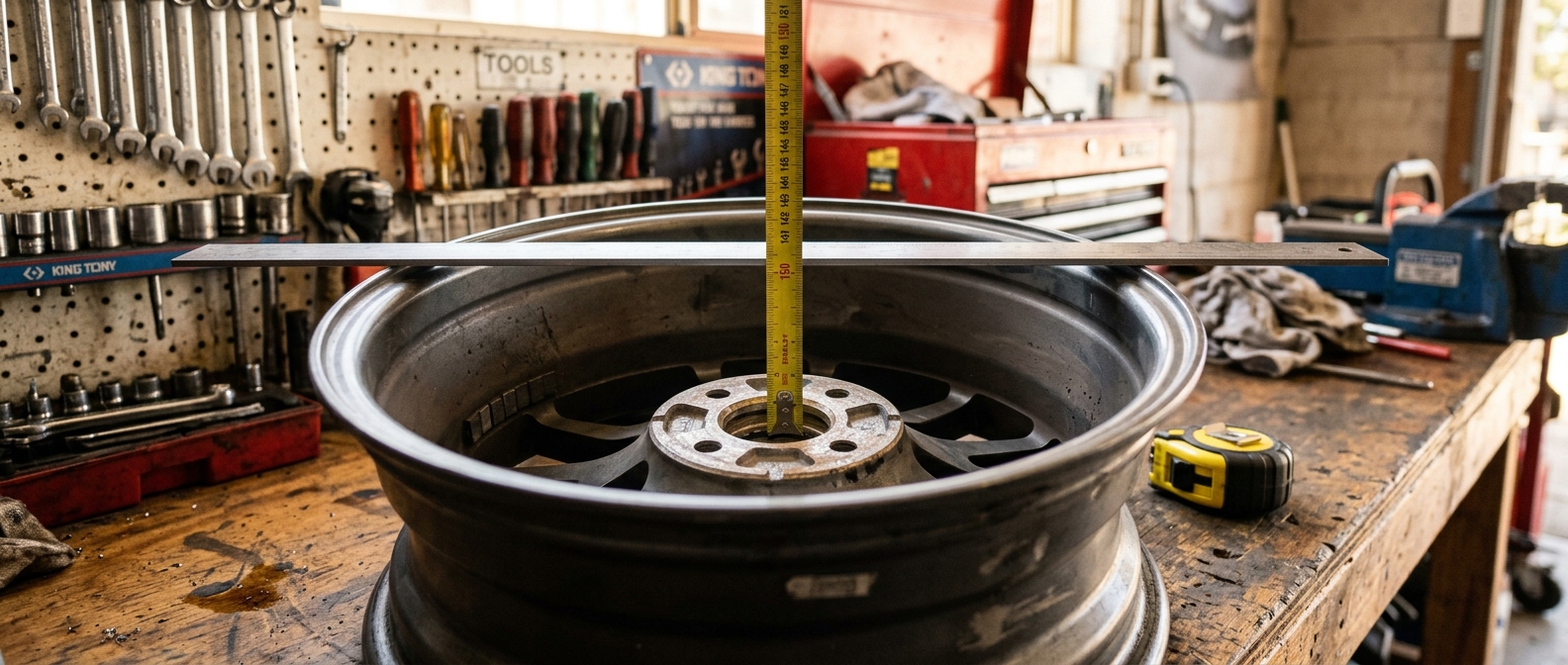
The short answer: Offset is how far a wheel's mounting face sits from its centreline, stamped as "ET" in millimetres. Positive offset tucks the wheel in; negative offset pushes it out ("poke"). Backspacing is the distance from the mounting face to the wheel's inner lip — measure it at home with a straight edge across the back and a ruler. Both control guard clearance, steering feel and, in Australia, whether your track change stays legal.
What is wheel offset?
Offset is the distance between the wheel's mounting face — the flat surface that bolts against your hub — and the true centreline of the wheel. It is measured in millimetres and marked on the wheel as ET (from the German Einpresstiefe, meaning "insertion depth"), so a wheel stamped ET38 has 38 mm of positive offset.
Offset decides how far in or out your wheel and tyre sit relative to the hub. Change it and you change the car's track width, the clearance to your guards and suspension, the load on your wheel bearings, and how the steering feels. It works hand-in-hand with the bolt pattern and centre bore to determine whether a wheel truly fits.
Positive, negative and zero offset explained
| Offset type | Mounting face position | What the wheel does |
|---|---|---|
| Positive (e.g. ET45) | Toward the outer/street side of the centreline | Pulls the wheel inward, tucking it under the guard. Standard on most front-wheel-drive cars and modern SUVs. |
| Zero (ET0) | Exactly on the centreline | Mounting face splits the wheel width evenly. |
| Negative (e.g. ET-12) | Behind the centreline, toward the brake side | Pushes the wheel outward, creating "poke" or stance. Common on deep-dish and many 4WD wheels. |
The practical trade-off: more positive offset gives more clearance on the outside edge but reduces space between the inner tyre edge and your suspension and brakes. More negative offset does the opposite — more inner clearance, but the wheel sits further out toward (or past) the guard. Push it too far and the tyre catches the guard lip; not far enough and it fouls the strut or caliper.

What is backspacing?
Backspacing is the distance from the wheel's mounting face to the inner lip (the back edge) of the rim. Where offset is measured from the centreline, backspacing is measured from the very back of the wheel — so it directly tells you how much room the wheel needs on the suspension side. It's the number 4WD and ute owners care about most, because too much backspacing is what makes a big tyre rub the strut or control arm.
Offset and backspacing describe the same geometry from two different reference points, so they're linked by a formula:
The half-inch accounts for the rim flanges the width figure doesn't include. In short: as offset gets more positive, backspacing increases; as offset gets more negative, backspacing decreases.
How do you measure wheel offset and backspacing yourself?
You don't need the wheel off the car to read offset — but you do need it off to measure backspacing accurately. Here's the DIY method with a straight edge (a spirit level or steel rule works) and a tape measure.
- Lay the wheel face-down on a flat surface so the back of the wheel points up.
- Measure overall width. Lay the straight edge across the back rim lip and measure to the front lip. This is the overall width — note it's about 1 inch (25 mm) more than the stamped rim width, because rim width is measured bead-seat to bead-seat, not lip to lip.
- Measure backspacing. Lay the straight edge flat across the inner rim lip, then measure straight down from the underside of the straight edge to the wheel's mounting face. That distance is your backspacing.
- Calculate offset if it isn't stamped on the wheel: Offset = Backspacing − (Overall width ÷ 2). Convert to millimetres by multiplying inches by 25.4.
Most wheels save you the trouble — the offset is cast or stamped on the back of a spoke or the inner barrel as "ET" followed by a number. If you can read "ET45", you already have your offset.
Why offset and backspacing matter for handling and safety
Changing offset isn't just cosmetic. Moving the wheel outward with lower offset widens your track, which can sharpen turn-in but also increases the leverage on your wheel bearings and steering components, accelerating wear. It changes the scrub radius, which alters steering feel and can make the car tramline or feel darty.
Fitment that's too far out can cause the tyre to wear unevenly or rub the guard under compression; too far in risks the tyre catching the strut or brake caliper on full lock. Getting offset right is as important as getting the rim width to tyre width right — the two together decide where the tyre actually sits in the arch.
Is changing wheel offset legal in Australia?
This is where Australian owners need to be careful. Fitting wheels with a different offset changes your track width — the distance between the centres of the tyres on the same axle. Nationally, guidance based on Vehicle Standards Bulletin 14 and adopted by most states allows a track increase of up to a set amount before certification is required — commonly cited as around 25 mm for passenger cars and up to 50 mm for many 4WDs measured against the widest factory option, provided the tyres stay within the guards.
These figures and how they're enforced vary by state and by vehicle, so treat them as a starting point, not gospel. Going beyond the allowance — or having tyres that poke past the mudguards — can mean you need an engineer's certificate, and running non-compliant fitment can also affect your insurance. Always confirm the exact limits with your state road authority before changing offset.
How much offset change is safe?
As a rule of thumb, staying within about 5 mm of your factory offset is usually invisible in daily driving. Beyond that, you start trading clearance on one side for clearance on the other. Wheel shops and fitment databases publish the safe offset range for your specific car — use them rather than guessing, and remember that spacers only reduce effective offset (push wheels out), never increase it. If you're combining an offset change with wider rubber, cross-check our safe wider-tyre range guide too.
Bottom line: Offset (the "ET" number) sets how far your wheel sits in or out; backspacing sets how much room it needs behind. Read the ET stamp or measure backspacing with a straight edge and ruler, keep offset within a few millimetres of factory, and check your state's track-width rules before you push wheels wider.
Frequently asked questions
What does ET mean on a wheel?
ET is the offset in millimetres. It comes from the German word Einpresstiefe ("insertion depth"). ET45 means 45 mm of positive offset — the mounting face sits 45 mm toward the outer face from the wheel's centreline.
Is offset or backspacing more important?
They describe the same geometry, so neither is "more" important — but wheel makers quote offset (ET), while 4WD and ute owners often think in backspacing because it directly predicts inner clearance. Know both, and be able to convert between them.
Can I fit wheels with a different offset than factory?
Within a small range (roughly ±5 mm) usually causes no issue. Larger changes affect handling, bearing life and guard clearance, and can push your track width past the legal allowance — which may require certification. Check with your state road authority and a wheel specialist first.
What happens if the offset is too low (too negative)?
The wheel sits further out. You get more aggressive stance and more inner clearance, but the tyre can rub or extend past the guard, load the bearings harder, and fail a roadworthy inspection if it pokes beyond the mudguard.
How do I measure backspacing at home?
Lay the wheel face-down, rest a straight edge across the inner rim lip, and measure from the underside of the straight edge down to the mounting face. That distance is your backspacing.
Track-width allowances and certification rules differ between states and vehicles. Confirm the exact limits with your state or territory road authority and check the relevant Vehicle Standards Bulletin before changing wheel offset. For fitment ranges, use a reputable calculator such as the Tyroola offset guide and confirm with a licensed wheel supplier.

0 Comments