
The short answer: Most Australian drivers don’t need wheel spacers. In Australia, spacers or adaptors between the hub face and the wheel must not be used unless they were fitted as original equipment by the manufacturer (VSB 14). They can widen your stance and clear big brakes, but they add stress to studs and bearings and can void insurance. A correct-offset wheel is almost always the better fix.
Wheel spacers are one of the most argued-about modifications in the Australian scene. On social media they’re sold as a cheap way to get a wider, more aggressive stance or to clear a suspension upgrade. In the workshop, they’re the part that makes an experienced fitter wince. This guide explains what spacers actually do, where the genuine engineering cases are, and why the legal and safety picture in Australia is stricter than most online sellers admit.
What is a wheel spacer and what does it do?
A wheel spacer is a machined metal disc that mounts between your hub face and your wheel, pushing the wheel outboard by the thickness of the spacer. A 15mm spacer moves the wheel 15mm further from the car. In effect, it reduces the wheel’s offset without changing the wheel itself.
People fit spacers for three main reasons: to widen the track for a wider stance or a marginal stability gain; to clear larger brake callipers or suspension components that the standard wheel fouls; and to correct the fitment of a wheel whose offset sits slightly too far inboard. All three of those goals can usually be met a safer way, which we’ll come to.
Slip-on vs bolt-on (hub-centric) spacers
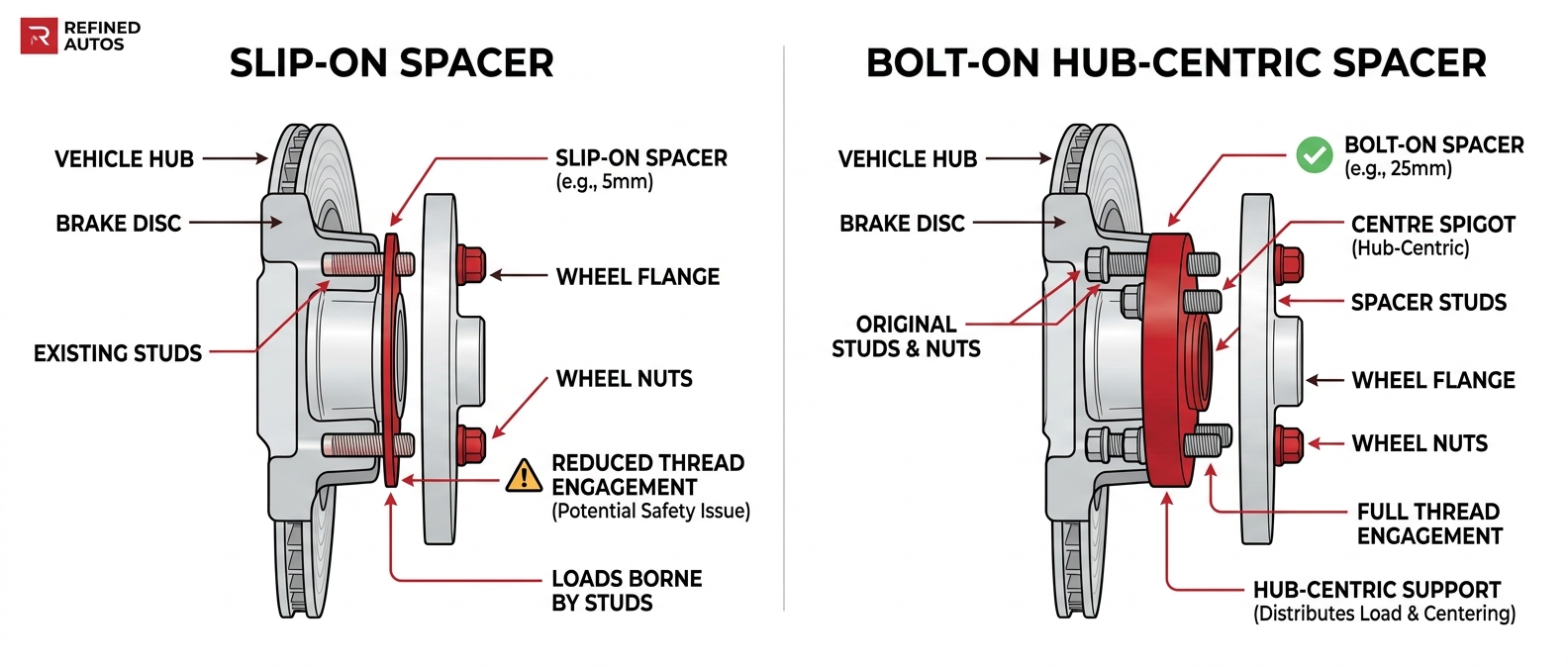
There are two broad types, and the difference matters enormously for safety:
| Type | How it mounts | Risk profile |
|---|---|---|
| Slip-on (thin) spacer | Slides over the existing studs; the original nuts then hold both spacer and wheel. Usually 3–5mm. | Highest risk. Reduces the thread engagement on your original studs. Often not hub-centric, so the studs carry weight the hub should carry. |
| Bolt-on (hub-centric) spacer | Bolts to the hub with its own fasteners, then presents its own studs and a machined centre spigot for the wheel. | Lower risk when correctly engineered and torqued, because it restores full stud engagement and centres the wheel on a spigot. Still an aftermarket part. |
A hub-centric spacer restores the locating job that your centre bore normally does, so the wheel is held true by metal-on-metal contact rather than by the nuts alone. If you understand hub-centric vs lug-centric fitment, you already understand why a thin slip-on spacer that leaves the wheel lug-centric is the worst of both worlds.
Are wheel spacers legal in Australia?
This is where the online sales pitch and Australian reality part ways. The National Code of Practice for Light Vehicle Construction and Modification (VSB 14) is explicit: wheel spacers or adaptors fitted between the wheel mounting face and the road wheel must not be used unless they were fitted as original equipment by the vehicle manufacturer. That’s a national baseline, not a state quirk.
On top of that, every state limits how much you can increase your track (the distance between the wheels on an axle) before the car needs certification. As a guide, several jurisdictions use figures around 25–26mm of total track increase over the manufacturer maximum before an engineering assessment is required — and a spacer increases track by twice its thickness across the axle. But because the OE-only rule above sits over the top of the track figure, passing the track number does not automatically make a spacer legal.
Interpretation and enforcement vary, and some fitters will engineer a hub-centric setup for off-road use. The safe course is simple: check whether your setup needs an engineer’s certificate and confirm the current rule with your state or territory road authority before you buy. Don’t rely on a seller’s “road legal” claim.
What spacers do to your insurance
Undisclosed modifications are a fast way to lose a claim. If a spacer isn’t declared and isn’t legal, an insurer can treat the policy as misrepresented from the start — whether or not the spacer caused the incident. Before fitting anything, read our guides on whether changing wheel size voids your insurance and whether you have to tell your insurer about aftermarket wheels.
What are the real risks of wheel spacers?
Even a well-made spacer changes the physics at the corner of your car:
- Bearing load. Pushing the wheel outboard lengthens the lever arm on the wheel bearing, increasing side load during cornering and braking. Over time this is a recognised cause of accelerated bearing wear.
- Stud stress. Thin slip-on spacers reduce how far your nuts thread onto the original studs. Too little thread engagement is a genuine failure risk. A rule many fitters follow is that a nut should engage at least the stud’s diameter in thread length.
- Changed scrub radius and steering feel. Widening the track alters steering geometry, which can add kickback over bumps and change how the car behaves under emergency braking.
- Stability control calibration. Electronic stability systems are tuned to the factory track. Move it and the system can intervene at the wrong moment.
- Guard clearance. A wider track can push the tyre toward or past the guard, which is both a compliance and a rubbing problem.
If you do run a legal, engineered hub-centric spacer, treat it like any critical fastener: torque to spec and re-torque after the first drive, and check your wheel nut torque figures rather than trusting a rattle gun.
When do spacers actually make sense?
There is a narrow band of legitimate use. Motorsport and off-road builds sometimes need a specific track width or clearance that no off-the-shelf wheel offset delivers, and there a properly engineered, certified hub-centric spacer can be the correct answer. The key words are engineered and certified. For a daily-driven road car, the honest answer is that the goal — stance, brake clearance, or corrected fitment — is nearly always better achieved by choosing a wheel with the right offset and backspacing in the first place.
The better alternative: get the offset right
Before buying spacers, work out the wheel that would fit without them. Nail your bolt pattern and PCD, your centre bore, and the offset you need, then check the tyre against the rim using our rim width to tyre width chart and the safe range for fitting wider tyres. A correct-offset wheel carries the load on its hub, keeps you inside the guards, and sidesteps the whole spacer legality question. If you’re chasing a genuinely wider look front and rear, a staggered setup on the right wheels is a cleaner path than spacers.
Bottom line: wheel spacers solve a problem most Australian cars don’t have, and they create legal, insurance and mechanical problems that a correctly chosen wheel avoids entirely. Under VSB 14 they’re OE-only on the road, so unless you’re building a certified off-road or track vehicle, spend the money on the right offset wheel instead of a spacer.
Frequently asked questions
Are 5mm slip-on wheel spacers safe?
They are the riskiest type because they reduce thread engagement on your original studs and are usually lug-centric, forcing the studs to carry weight the hub should carry. Many fitters won’t fit them. A properly engineered hub-centric spacer with its own studs is a safer design, but on Australian roads the VSB 14 OE-only rule still applies.
Do wheel spacers ruin your wheel bearings?
They don’t ruin them overnight, but by moving the wheel outboard they increase the load on the bearing during cornering and braking, which shortens bearing life. The thicker the spacer, the greater the effect.
Can I get wheel spacers certified in Australia?
In some cases an engineer may assess and certify a hub-centric spacer setup, typically on off-road or modified vehicles, but this varies by state and isn’t guaranteed. Confirm the pathway with your state road authority and a licensed engineering signatory before buying.
What’s the alternative to wheel spacers?
A wheel with the correct offset, PCD and centre bore for your car. It achieves the same stance or clearance goal, keeps the load on the hub, and avoids the spacer legality problem.
Figures for track-increase limits and certification are a guide only and change between states and over time. Always confirm the current rules with your state or territory road authority. External references: Australian Government VSB / National Code of Practice; CarsGuide: Are wheel spacers legal in Australia?

0 Comments