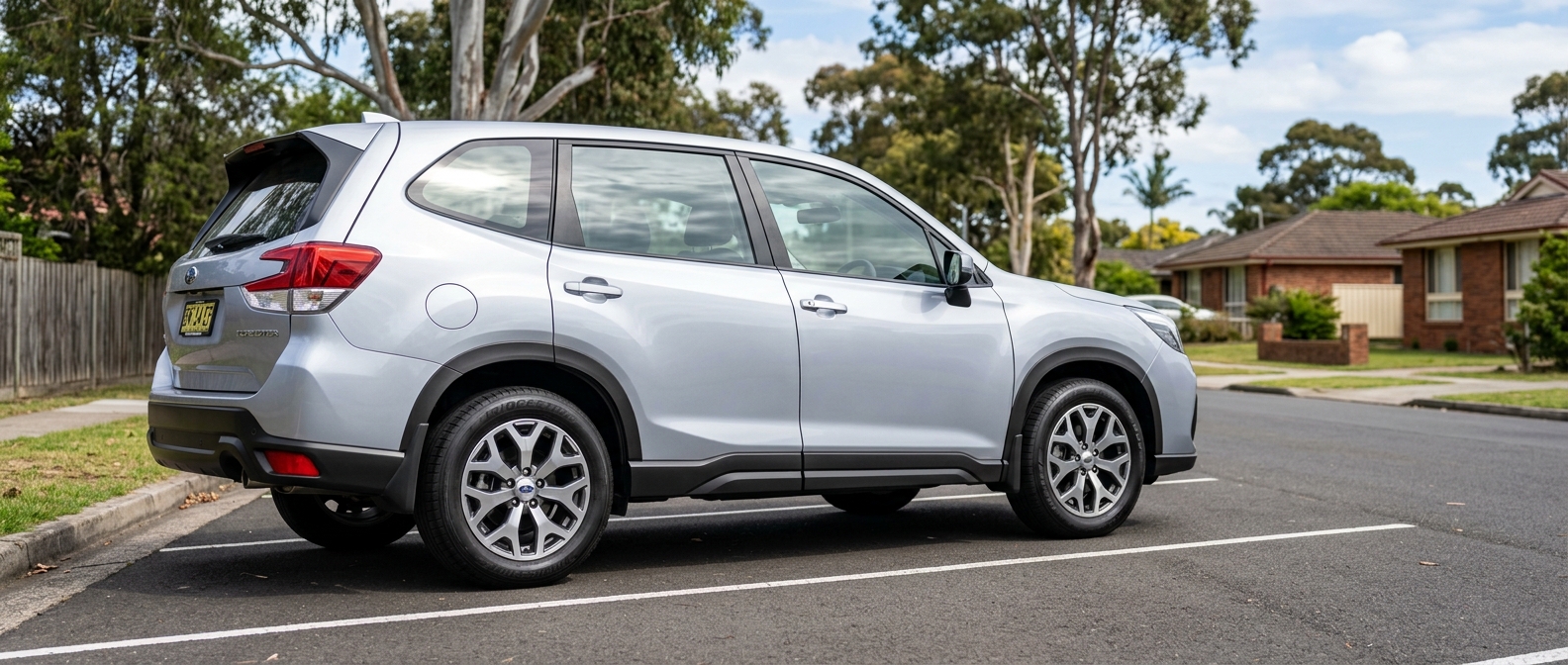
Quick answer (TL;DR): No — you shouldn’t run different tyre sizes front and rear on an all-wheel drive unless the vehicle was designed that way from the factory (a staggered setup). Mismatched rolling diameters make the AWD system think the wheels are constantly slipping, generating heat that can wreck the centre differential or coupling — a $1,000–$5,000+ repair. Even worn-versus-new tyres of the same size can breach the tolerance.
Why does an AWD care about tyre size front to rear?
On a two-wheel-drive car, the driven wheels turn independently of the free-rolling ones, so a size difference front to rear is mostly a handling and legality question. An AWD is different: its centre differential, viscous coupling or clutch pack mechanically links front and rear axles so it can send drive to whichever end has grip.
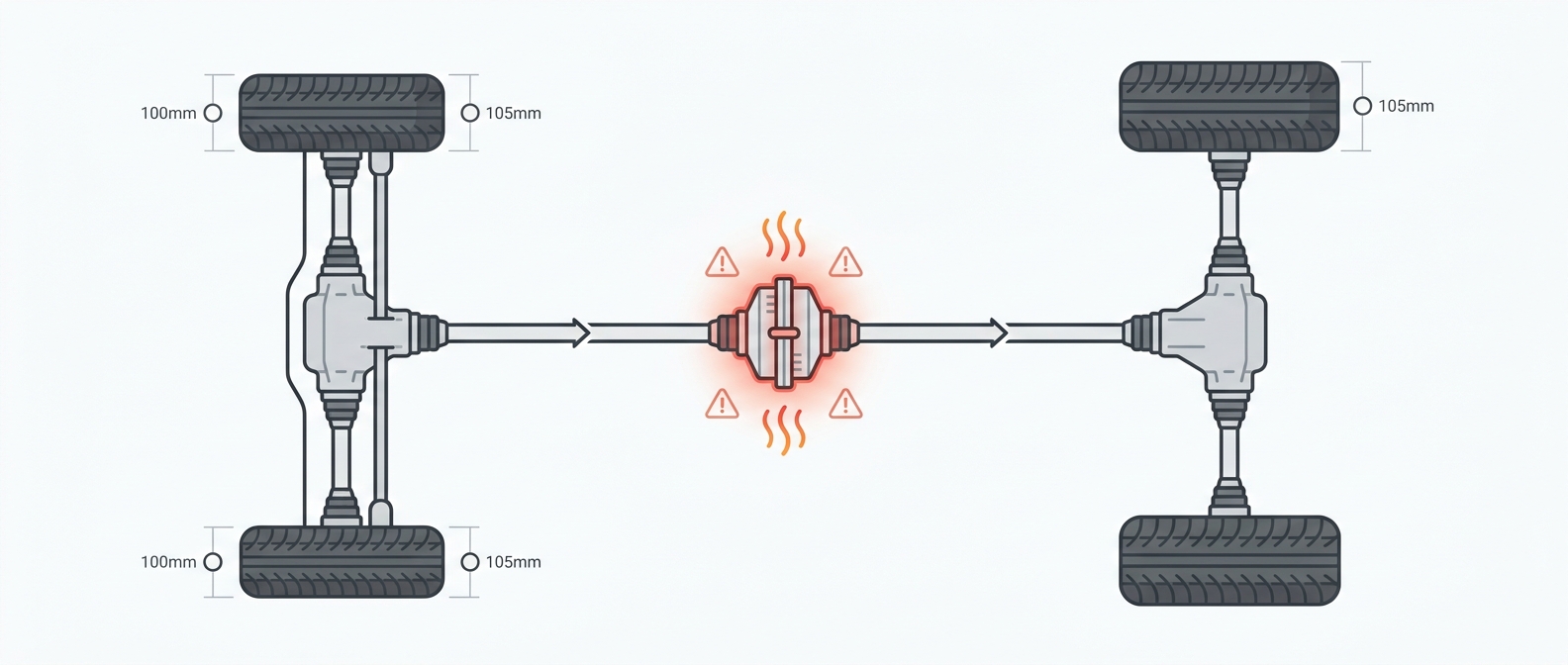
If the front and rear tyres have different rolling diameters, one axle turns faster than the other at the same road speed. The AWD system reads that permanent speed difference as wheel slip and tries to compensate — continuously, everywhere, even in a straight line on dry bitumen. That constant correction builds heat in the coupling and gears.
What actually gets damaged?
The parts that manage the front-to-rear speed difference cop the punishment: the centre differential, the transfer case, and the viscous or electronically-controlled coupling. Sustained heat cooks the fluid and wears the internals, leading to “torque bind” (a juddering, tight feeling in slow tight turns) and eventually failure. Replacement couplings and transfer cases commonly run from about $1,000 well past $5,000 — many times the price of a single tyre. Australia’s summer heat only adds to the thermal load these components are already fighting.
How close do the tyres actually have to be?
Closer than most people expect. The tolerance is measured in rolling circumference or diameter, and it’s tight:
| AWD system | Typical max difference (guide) |
|---|---|
| Subaru (symmetrical AWD) | ≈ 1/4 inch (~6mm) circumference, roughly 1% |
| Honda i/SH-AWD | ≈ 1/4 inch, roughly 1% |
| Audi quattro | ≈ 0.5% overall diameter |
| BMW xDrive | ≈ 3mm circumference |
| Toyota / Lexus AWD | ≈ 1/2 inch, roughly 1.5% |
These are guides only — always check your owner’s manual for the exact figure. The key point: this is far tighter than the legal fitment tolerances, and it means even the tread-depth difference on an AWD matters, because a worn tyre has a smaller effective diameter than a new one of the same size.
So can you ever run different sizes front and rear?
Only one scenario makes it safe: a factory staggered setup, where the manufacturer designed the AWD driveline around specific different front and rear sizes (common on some performance AWDs). The gear ratios and coupling are engineered to match those exact rolling diameters. If your car is staggered from the factory, you must keep to the OE staggered specification — you can’t invent your own. We cover the concept in full in staggered wheel setups: what they are and who should run one.
Everything else — fitting bigger tyres on one axle, running a different brand or model with a different diameter front to rear, or leaving a worn pair on one end and new on the other — falls outside the tolerance and risks the driveline.
What about a puncture and the spare?
A space-saver spare has roughly a 3% smaller diameter, which is why makers limit it to around 80 km/h and 80 km. That short-distance allowance shows a minor, brief mismatch won’t instantly destroy the driveline — but it’s an emergency measure, not a way to run mismatched tyres long-term. Fit the spare, drive gently, and get the correct tyre back on as soon as you can.
Do you have to replace all four tyres on an AWD?
Not always. If one tyre is damaged and the other three still have plenty of tread, you have options:
- Repair, don’t replace, where the damage is a repairable puncture — this keeps all four matched. See nail in the tyre: repairable or replace?
- Tyre shaving: some specialist retailers can shave a new tyre down to match the worn set’s diameter, avoiding a full replacement.
- Replace in axle pairs only if the remaining pair is close in diameter to new — and always keep matching tyres on the same axle.
If the tread difference is large, replacing all four is the safe path. The full cost trade-off is in do you need to replace all four tyres at once and do AWD cars really need all four tyres replaced together.
Is it even legal in Australia?
Beyond the mechanical risk, tyres on the same axle must match in size, construction and type, and different sizes front-to-rear are generally only lawful when that’s the vehicle’s design. The rules sit alongside the questions of running different tyre sizes front and rear legally and mixing tyre brands front and rear. Confirm the detail with your state road authority.
Bottom line: Treat all four tyres on an AWD as a matched set. Same size, same model, and diameters within about 1% — measured in tread depth as well as size. The only safe exception is a genuine factory staggered fitment. When in doubt, match all four; a coupling costs far more than a tyre.
Frequently asked questions
Can I put bigger tyres on the back of my AWD only?
No. Unless the vehicle is a factory staggered design, different front and rear diameters force the AWD system to compensate constantly, overheating the centre coupling or differential and risking expensive failure.
How different can AWD tyres be before it causes damage?
Very little — typically within about 1% rolling circumference (roughly 6mm), and some systems demand tighter. Check your owner’s manual, and remember worn-versus-new tyres of the same size can already exceed it.
Will a space-saver spare hurt my AWD?
Not if used as intended: low speed and short distance (commonly 80 km/h and 80 km). It’s a smaller diameter, so it stresses the driveline — fine briefly in an emergency, but not for extended driving.
Do I really need to replace all four tyres on a Subaru?
If the existing tyres are worn, often yes, because the diameter gap to a new tyre can exceed Subaru’s roughly 1/4-inch limit. If the other three are near-new, repairing the damaged one or shaving a replacement to match can save a full set.
What are the symptoms of AWD tyre mismatch damage?
Torque bind — a tight, juddering or binding feeling during slow, tight turns — plus unusual driveline noise or heat. If you notice this after fitting mismatched tyres, have the tyres and coupling checked promptly.
Suggested schema: Article + FAQPage.

0 Comments