Fines and Demerits for Illegal Tyres in Australia
Tyres are cheap to check and expensive to ignore. A single bald tyre can turn into a fine, demerit points, a defect notice and — if you crash — an insurance headache. Here’s how the penalties work in Australia and why the total can climb faster than people expect.
What makes a tyre illegal in Australia?
A tyre is illegal (unroadworthy) if it fails the national vehicle standard. The most common breaches are:
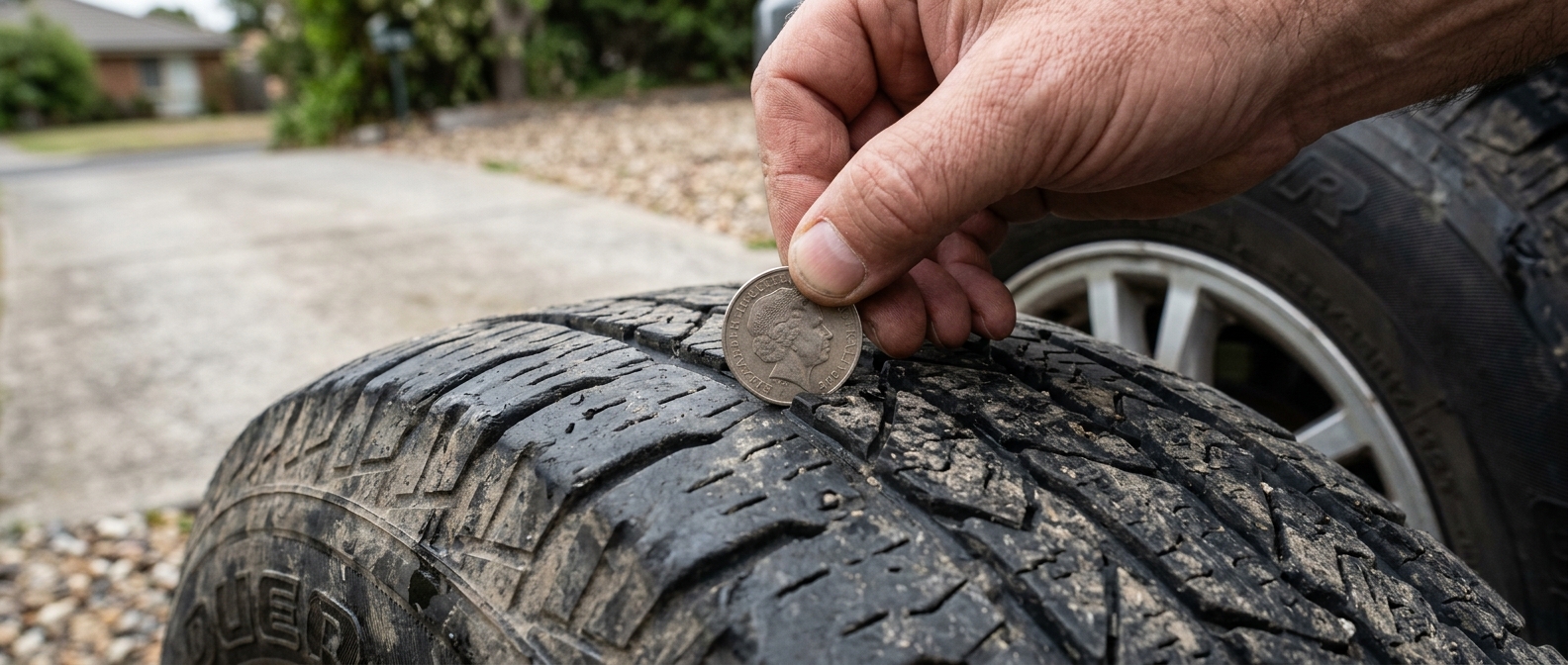
- Tread worn below the legal minimum of 1.5 mm in the principal grooves, measured across the central three-quarters of the tread around the whole circumference. This is the Australian figure — many websites quote 1.6 mm, which is the UK rule. See the 1.5 mm rule explained.
- Cord or belt showing, deep cuts, bulges or a sidewall bubble.
- Tyres that don’t meet the vehicle’s placard load or speed rating, or the wrong size for the fitment.
- Unsafe or illegal repairs, or mismatched tyres where the rules don’t allow it.
Not sure if yours pass? Start with checking tread depth without a gauge and reading your tyre wear indicators.
How much is the fine for illegal tyres?
Each state and territory sets its own penalty, and amounts are reviewed regularly (often annually with penalty-unit indexation). As a guide, a single defective tyre commonly attracts an on-the-spot fine in the low hundreds of dollars plus a demerit point or two, with the total multiplying for each additional non-compliant tyre.
| Situation | Typical outcome (guide only) |
|---|---|
| One bald / defective tyre | On-the-spot fine (roughly $110–$300 depending on state) + demerit point(s) |
| Multiple bald tyres | Penalty charged per tyre — e.g. three tyres can triple both the fine and the points |
| Alongside the fine | A defect notice requiring repair and re-inspection |
A widely cited concrete example is Queensland, where retailer guidance describes roughly a $110 fine and 1 demerit point for a single bald tyre, and around $220 and 3 demerit points where three tyres are involved. Other states publish their own tyre-related offence codes and amounts — you can look up current figures via Transport for NSW or Fines Victoria. Because these figures move, check your own state’s current offence list before assuming a number.
Why penalties are charged “per tyre”
This is the part that catches people out. Tyre offences are generally assessed on each non-compliant tyre, not the car as a whole. Neglect all four and you are not looking at one fine — you could be looking at four, plus the matching demerit points on each. A cheap set of tyres is almost always cheaper than the fines, so the maths rarely favours running them bald.
Do you also get demerit points?
Yes, in most states a defective-tyre infringement carries demerit points as well as the fine. Points matter because they accumulate against your licence threshold and can push you toward suspension if you already have others. As with the dollar figures, the exact points depend on the state and the specific offence.
What about a defect notice on top?
A roadside stop can produce both an infringement (the fine and points) and a defect notice (the order to fix and re-inspect). They are separate things — paying the fine does not clear the defect, and clearing the defect does not cancel the fine. Read tyre defect notices: what gets you a yellow or red sticker for how clearance works.
The bigger cost: insurance and liability
The fine is often the smallest number involved. If you have a crash on illegal tyres, an insurer can scrutinise the claim, and non-compliance or non-disclosure of modifications can affect the outcome. See does changing wheel size void your insurance and telling your insurer about aftermarket wheels.
Bottom line: Illegal tyres are penalised per tyre, usually with a fine plus demerit points, and the amount varies by state and is reviewed each year. Treat any figure you read — including ours — as a guide, confirm the current amount with your road authority, and replace worn tyres before an officer does the maths for you.
Frequently asked questions
How much is the fine for bald tyres in Australia?
It varies by state and changes over time. As a guide, a single defective tyre is commonly in the low hundreds of dollars plus demerit points; Queensland guidance cites about $110 and 1 demerit for one tyre. Confirm the current figure with your state road authority.
Is the fine per tyre or per car?
Generally per tyre. Multiple bald tyres usually mean multiple fines and multiple lots of demerit points, so neglecting all four can be several times the single-tyre penalty.
What is the legal minimum tread depth?
1.5 mm in the principal grooves across Australia — not 1.6 mm. Many retailers recommend replacing at 3 mm for wet-weather safety, but 1.5 mm is the legal line.
Will illegal tyres cost me demerit points?
In most states, yes — a defective-tyre infringement typically carries demerit points as well as the fine, and points accumulate toward licence suspension.
Can I be fined and defected for the same tyres?
Yes. An infringement (fine + points) and a defect notice (fix and re-inspect) are separate and can both be issued at the same stop.
This article is general information for Australian drivers and reflects the position in 2026. Fine amounts and demerit points differ between states and territories and are updated regularly — always confirm current penalties with your state or territory road authority.


0 Comments