Refined Autos · Australian Legality & Compliance
TL;DR: Tasmania has no blanket roadworthy check for private used-car sales, but tyres are still assessed whenever an inspection is triggered — interstate transfers, lapsed re-registration, modified or written-off vehicles, and heavy or public passenger vehicles. The tyre pass mark is at least 1.5 mm of tread across the whole width, with no cuts, bulges or exposed cords. Confirm current rules with Transport Tasmania.
Tyre Rules for a Tasmanian Vehicle Inspection
If you’re buying, importing or modifying a vehicle in Tasmania, the question of whether your tyres will pass a Tasmanian vehicle inspection comes down to two things: whether an inspection is required at all, and whether your rubber meets the state’s minimum tyre standards. Unlike a NSW pink slip, Tasmania doesn’t inspect every car every year — but when an inspection does apply, worn or damaged tyres are a common and avoidable reason to fail.
This guide explains when Tasmania requires an inspection, the exact tyre criteria a Vehicle Examiner checks, and how to make sure your tyres are ready. Figures here reflect published guidance as a guide only; always confirm the current standard with Transport Tasmania or your Approved Inspection Station.
When does Tasmania actually require a vehicle inspection?
Tasmania does not have a general periodic roadworthy requirement for privately owned light vehicles, and there’s no mandatory roadworthy certificate simply to sell or transfer a Tasmanian-registered car between private parties. That surprises a lot of interstate arrivals. Instead, an inspection is triggered by specific circumstances:
- Registering a vehicle from interstate in Tasmania (or an imported vehicle).
- Re-registering a vehicle whose registration has lapsed or been cancelled.
- Modification inspections (through the AVCAIS scheme) for engineered or modified vehicles.
- Repairable write-off structural inspections (AMBRIS) before a written-off vehicle returns to the road.
- Public passenger vehicles — taxis, hire cars and similar — which face periodic inspections.
- Heavy vehicles, which have their own inspection obligations.
- Clearing a defect notice issued by police or a transport inspector (including a tyre defect).
General inspections are carried out by Vehicle Examiners at Approved Inspection Stations (AIS) around the state. If your situation isn’t on the list above, you may not need a formal inspection — but your tyres still have to meet the in-service legal minimum every day you drive, and a defect notice can be issued at any roadside check.
What tread depth do your tyres need to pass in Tasmania?
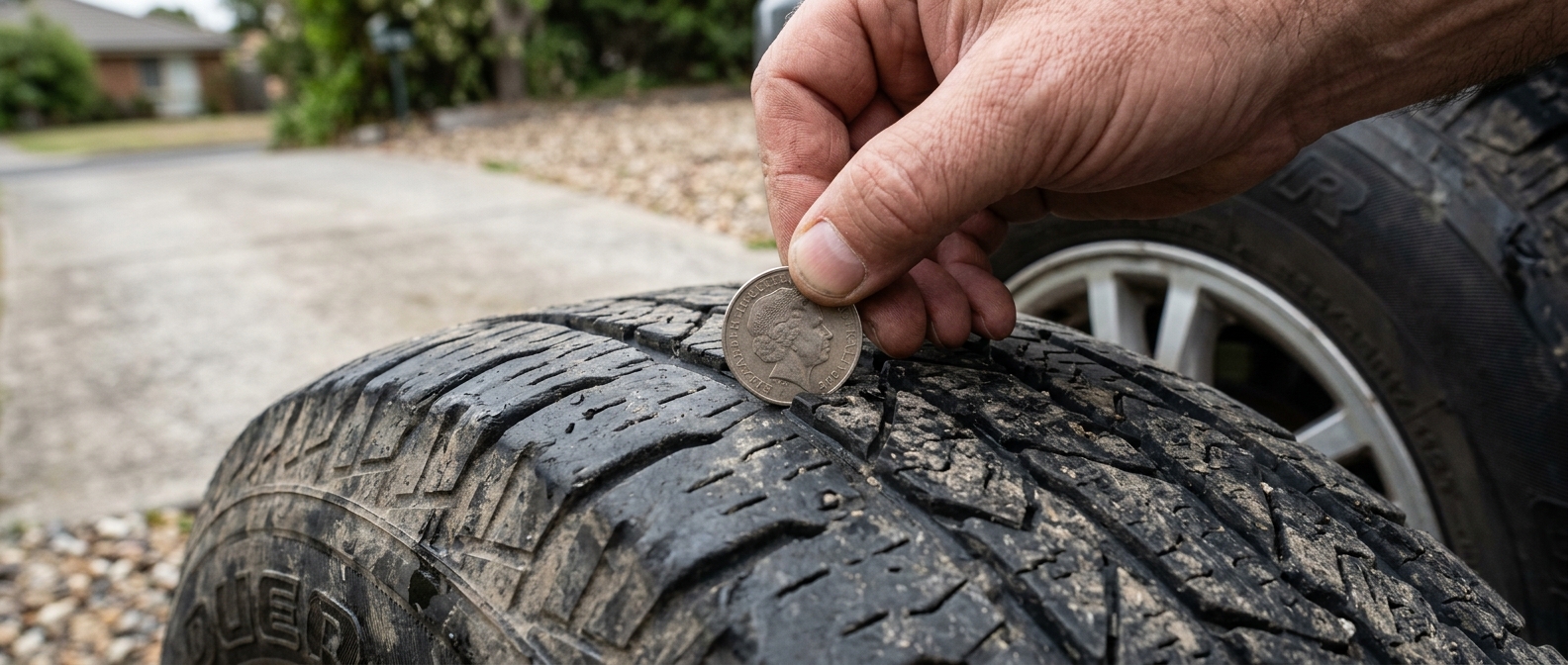
The Tasmanian minimum tread depth is 1.5 mm measured over the entire tread width of the tyre, and the tyre must not be flat. This matches the national in-service standard applied across every Australian state and territory — it is 1.5 mm, not the 1.6 mm figure often quoted from UK or European sources. If you’ve read 1.6 mm somewhere, that figure does not apply in Australia.
Every modern passenger tyre has moulded tread wear indicators (TWIs) — small raised bars sitting at the bottom of the main grooves at exactly 1.5 mm. When the surrounding tread wears flush with those bars, the tyre is at the legal limit and must be replaced. Learn where they sit in our guide to tyre wear indicators, and check yours at home using the method in how to check your tread depth without a gauge.
| Tyre check | Tasmanian pass condition (guide) |
|---|---|
| Tread depth | At least 1.5 mm across the entire tread width |
| Tread wear indicators | Tread not worn flush with the TWI bars |
| Structural damage | No deep cuts, bulges, exposed cords or carcass failure |
| Inflation | Tyre correctly inflated, not flat |
| Same-axle match | Tyres on the same axle of matching size and construction |
| Load & speed rating | Not below the vehicle manufacturer’s minimum |
What tyre damage causes an automatic fail?
Tread depth is only half the story. A Vehicle Examiner will fail a tyre — and police can defect one at the roadside — for structural problems regardless of how much tread is left. Common fail items include deep cuts, bulges or blisters in the sidewall, exposed reinforcing cords, and any sign of carcass or tread separation. A bulge in particular signals internal damage and is never repairable; see why in our explainer on sidewall cracking and when it becomes dangerous.
Inspectors also look at fitment legality: tyres must carry a load rating at or above the vehicle manufacturer’s specification, and a speed rating not below the original spec. Mismatched sizes on the same axle, or a rolling diameter well outside the standard tolerance, can also fail. If you’ve upsized wheels, read what rolling diameter is and why it decides your legal tyre size before an inspection, and check whether your fitment meets the placard load rating.
How Tasmania compares to other states
The 1.5 mm tread minimum and the damage criteria are effectively the same nationwide, because they come from the national in-service vehicle standards. What differs is when each state forces an inspection. Tasmania and South Australia are alike in having no general private-sale roadworthy for light vehicles, whereas NSW, Victoria and Queensland require a check at transfer or renewal. Compare the triggers in our guides to South Australian inspections, the NSW pink slip, the Victorian roadworthy and the Queensland safety certificate. The underlying rule is national — see the 1.5 mm tread depth rule explained.
Bottom line: Tasmania won’t inspect your car just because you’re selling it privately, but any triggered inspection — and every roadside check — needs tyres with at least 1.5 mm of tread across the full width, no structural damage, and a load and speed rating that meets the manufacturer’s spec. Replace anything close to the wear bars before you book in.
Frequently asked questions
Do I need a roadworthy to sell my car privately in Tasmania?
No. Tasmania has no general roadworthy certificate requirement to transfer a Tasmanian-registered light vehicle between private parties. Inspections are triggered by interstate registration, lapsed re-registration, modifications, write-offs, public passenger vehicles and defect clearances. Always confirm your specific situation with Transport Tasmania.
Is the minimum tread depth in Tasmania 1.5mm or 1.6mm?
It’s 1.5 mm across the entire tread width. The 1.6 mm figure comes from the UK and Europe and does not apply anywhere in Australia, including Tasmania.
Will a tyre with plenty of tread still fail?
Yes. Deep cuts, bulges, exposed cords, tread separation, or a load or speed rating below the manufacturer’s minimum can all fail a tyre regardless of remaining tread depth.
Who inspects my tyres in Tasmania?
Vehicle Examiners at Approved Inspection Stations (AIS) conduct general inspections. Police and transport inspectors can also issue tyre defect notices at the roadside at any time.
What happens if my tyres fail?
You replace the non-compliant tyres and present the vehicle for re-inspection or clear the defect. A failed inspection item is a fix-and-prove requirement, not automatically a fine — though driving on illegal tyres can attract penalties.
This article is general information for Australian drivers, not legal advice. Tyre and inspection rules change — confirm the current requirements with Transport Tasmania or your Approved Inspection Station before relying on them.



0 Comments