Fitting second-hand tyres is one of the cheapest ways to get a car back on the road, and it is completely lawful in every Australian state and territory. What the law does not do is guarantee the tyre you buy is safe. Unlike the United Kingdom, Australia has no mandatory labelling or pre-sale inspection rules for used tyres, so a worn or internally damaged tyre can be sold looking perfectly fine. This guide explains exactly where used tyres stand legally, what makes one roadworthy, and how to avoid a false economy.
Are used tyres actually legal in Australia?
Yes. No state or territory bans the sale or fitting of second-hand passenger-car tyres. The rules that apply are the same in-service tyre standards that govern any tyre on a registered vehicle — they don’t care whether the tyre is new or used, only whether it is safe and correctly specified. In practice that means a second-hand tyre is legal to fit as long as it would pass a roadworthy inspection on your car.
The catch is enforcement. Because there’s no compulsory testing of part-worn tyres before sale, the burden of judging condition falls on the buyer and the fitter. A reputable tyre shop won’t fit a used tyre it considers unsafe, but a private seller has no such obligation.
What makes a second-hand tyre roadworthy?
To be legal on the road, a used tyre has to clear the same bars as a new one:
| Requirement | What it means |
|---|---|
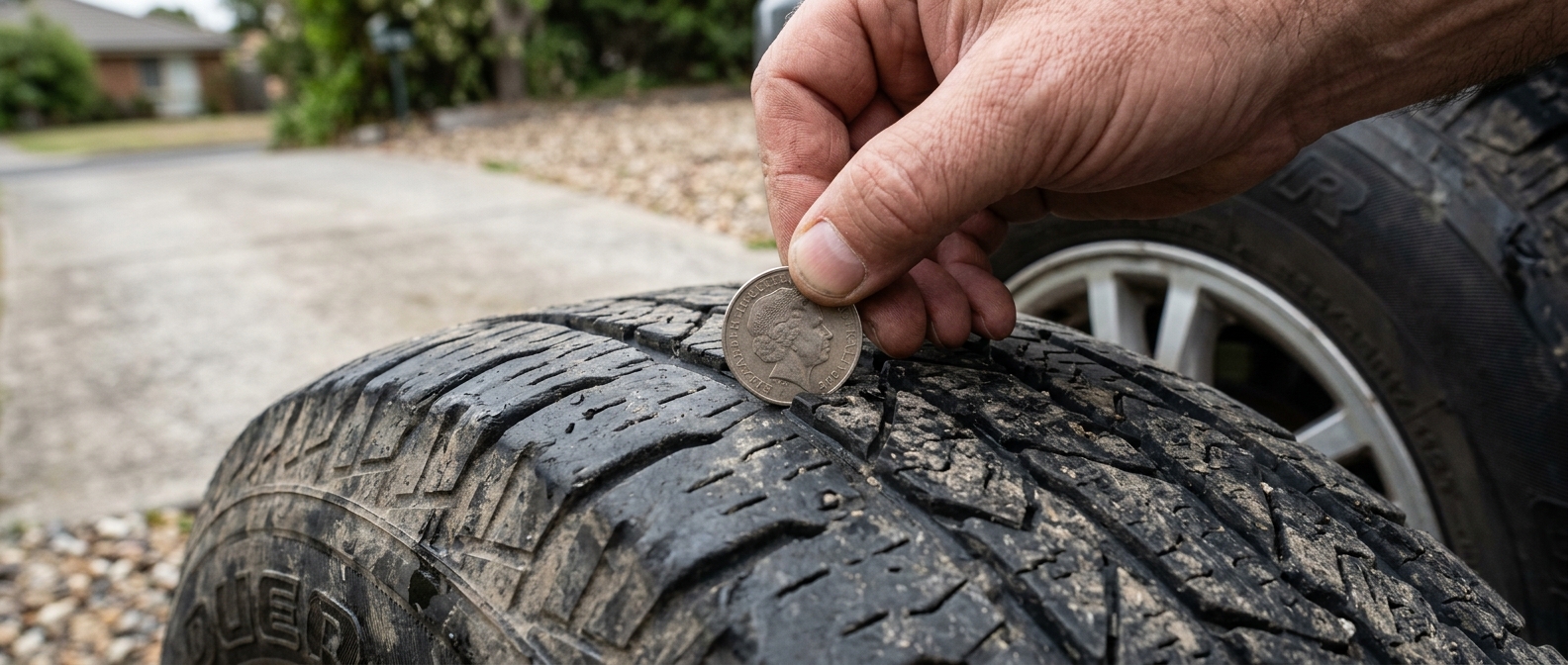
| Tread depth | At least 1.5 mm across all principal grooves (Australia’s legal minimum — not the UK’s 1.6 mm). Below this the tyre is unroadworthy. |
| Structural condition | No exposed cords or plies, no bulges or blisters, no deep cuts, no cracked or perished rubber. |
| Repairs | Any previous repair must sit within the legally repairable tread zone — not on the sidewall or shoulder. |
| Size & ratings | Correct size, and a load index and speed rating that meet or exceed your car’s tyre placard. |
| Matching | The pair on an axle should be the same size and construction; states require matched tyres across an axle. |
If a used tyre fails any of these, fitting it is illegal regardless of how much you paid. Check the tyre’s age too: read the DOT date code and be wary of anything already several years old, because rubber degrades with time as well as use — see our guide on whether to replace tyres over five years old.
Why cheap used tyres can be a false economy
The headline number that should give buyers pause is stopping distance. In one widely cited braking comparison, a new tyre with 8 mm of tread pulled up from 90 km/h in about 25.9 metres, while a used tyre worn to roughly 1.6 mm needed about 37.8 metres — nearly 12 metres further, or several car lengths, in the wet. A “legal” used tyre near the wear limit still brakes far worse than a fresh one.
Then there’s what you can’t see. A used tyre may have been run underinflated, kerbed, or driven flat, leaving internal damage that no external inspection reveals. It may carry a hidden, badly located repair. And because it starts life with less tread, it wears out sooner, so the cost-per-kilometre often works out worse than a budget new tyre. If a used tyre develops a slow leak or vibration after fitting, diagnosing it — see our guide to sidewall cracking — can cost more than you saved.
Do the rules change from state to state?
The core standard — 1.5 mm minimum tread and safe structural condition — is consistent nationwide. Where states differ is in how tyres are checked at inspection time: NSW uses the eSafety/pink slip system, Victoria a roadworthy certificate, Queensland a safety certificate, and WA, SA, Tasmania, the NT and the ACT run their own inspection regimes. A used tyre that’s legal to drive on today must also survive whichever inspection applies when you sell or re-register. You may have heard claims that certain states ban tyres over a set age; treat any specific age figure with caution and confirm the current rule with your state road authority, because these details change and vary by jurisdiction.
See our state-by-state breakdowns for the specifics: NSW pink slip, Victorian roadworthy and Queensland safety certificate. For the underlying tread rule, read the 1.5 mm minimum tread depth explained.
Your consumer rights when buying used tyres
A used tyre sold by a business still carries Australian Consumer Law guarantees — it must be of acceptable quality and fit for purpose. That gives you more recourse buying from a registered tyre shop than from a private ad or marketplace listing, where those guarantees generally don’t apply. When your old tyres are removed, they should be handled through an accredited recycler under the national product stewardship scheme run by Tyre Stewardship Australia rather than dumped.
Bottom line: Second-hand tyres are legal in Australia, but “legal to sell” is not the same as “safe to trust.” Buy only from a business that inspects and stands behind them, insist on 1.5 mm-plus tread with no damage, check the age code, and match size and ratings to your placard. If the saving is only $20–$40 a tyre over a budget new one, the new tyre is almost always the smarter buy.
Frequently asked questions
Is there a minimum tread depth for used tyres in Australia?
Yes — the same 1.5 mm in all principal grooves that applies to any tyre. A used tyre below that is unroadworthy and illegal to fit.
Can a tyre shop legally fit tyres I supply second-hand?
They can, but a reputable fitter will refuse if the tyre is unsafe, damaged, or wrongly sized, because fitting an unroadworthy tyre exposes them to liability.
Are second-hand tyres a good idea for one axle only?
Tyres on the same axle should match in size and construction, and it’s best practice to fit the deeper-tread tyres on the rear. Mismatched tyres can trigger stability-system and handling problems — more in mixing tyre brands front and rear.
How can I tell if a used tyre has hidden damage?
You often can’t from the outside. Ask when and where it was removed and why, check for repairs inside and out, read the DOT age code, and have a professional inspect the bead and inner liner before fitting.
Do used tyres void my insurance?
Fitting roadworthy used tyres won’t void a standard policy, but running unroadworthy tyres can give an insurer grounds to reduce or refuse a claim. Confirm with your insurer.
Figures for tread depth, inspection rules and penalties are current general guidance and vary by state; always confirm the rules that apply to your vehicle with your state or territory road authority.



0 Comments